

Featured image by Jeremy Thomas on Unsplash.
This year, particularly these last couple of months, has unfolded at a pace I can scarcely comprehend. My decision to take a sabbatical has taken me across different countries and continents (Malaysia, Australia, the UK, and now the US). I was fortunate to have spent a good part of the year in Kuala Lumpur, reconnecting with family, attending family weddings, and the funeral of my maternal grandfather, whom I wrote a little about here.
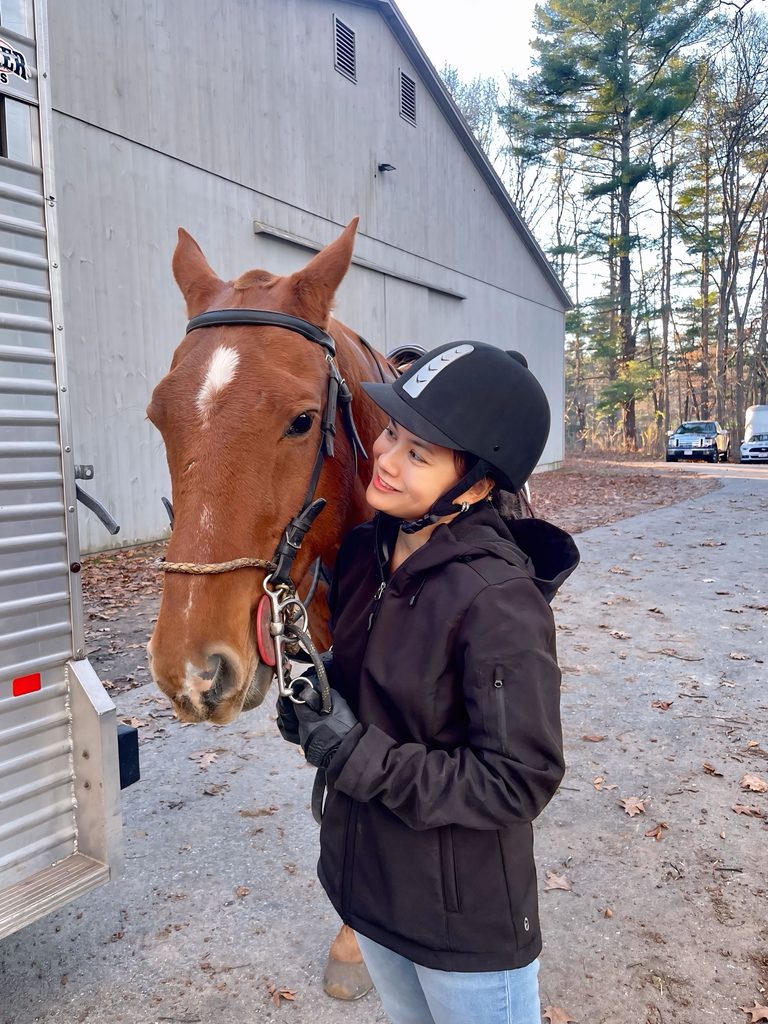
Today marks my first Thanksgiving. Reflecting on where I was this time last year, I can hardly believe that I am now at Harvard, pursuing a Master of Public Health in Health Policy. And learning to play polo. That, admittedly, is the wild card.
I have spent years searching for and creating meaning because I do not want to live a life wasted. Life is short, and I want to explore the possibilities available to me, exercising good judgement in the pursuit of human flourishing. I never consciously set out to be an avid Aristotelian, but rereading some of my articles on this website made me realise how much of my life has been guided by the pursuit of human flourishing (eudaimonia). It also made me realise that I have been working like a horse. Perhaps I ought to exercise a little more practical wisdom (phronesis) in recognising my own limits.
Lately, I have been thinking about artificial intelligence (AI) and what its advancement means for scientists. AI may become better than us at discovering novel proteins and solving century-old mathematical conundrums. What, then, is left for us to do?
But that is to view science through an instrumental lens, valuing it primarily for what it produces. What about doing science for the sheer enjoyment of it? What if there need not be any grander reason beyond the intellectual pleasure of formulating hypotheses, experimenting, drawing conclusions and sharing our discoveries with the world?
I must admit that, by the same token, I have been viewing myself through a rather instrumental lens.
What is Hannah if she does not achieve? What is Hannah if she does not have a purpose? Where, in all of this, is the pleasure of simply being Hannah?
When I first encountered Albert Camus, I found his philosophy somewhat insane. His intellectual meanderings on the apparent indifference of the universe to our search for meaning struck me as deeply pessimistic, if not fatalistic. Yet, paradoxically, he argued that the absence of an ultimate meaning was not a reason to end one’s life, but an invitation to live it fully, in defiance of the absurd.
I initially found this rather hedonistic, an impression reinforced by his discussion of figures such as Don Juan, who embraces numerous romantic experiences without seeking eternal love. Having long associated a life well lived with purpose, virtue and meaningful endeavour, I found the notion of embracing life simply for the experience of living it almost indulgent.
Yet, as the example of Sisyphus makes clear, Camus is not advocating an endless pursuit of pleasure. His emphasis is on living consciously and fully without appealing to some higher purpose to justify existence.
I did not quite appreciate his philosophy until I started playing polo.
I had no compelling reason to learn polo. It had nothing to do with my career, my academic ambitions, or any greater contribution I wished to make to society. I simply enjoyed it. And that enjoyment, in itself, was sufficient.
Thinking back to my years in boarding school, medical school, and the subsequent decades of academic and professional pursuits, I find myself wondering when I last did something purely because it delighted me, without considering its utility to my career or to society.
But is this not what many of us have been conditioned to do? From an early age, we inherit the religious beliefs, moral values, and philosophies of our parents. We are encouraged to make something of ourselves, to become useful members of society, and to contribute to something greater than ourselves. These are worthy aspirations. Yet, somewhere along the way, perhaps we have conflated the value of our existence with the value of our contributions.
Science, too, is increasingly viewed as a means to an end. Scientists are expected not only to be proficient in the scientific method but also to be adept at grant-writing, entrepreneurship, advocacy, and articulating the societal and economic impact of their research. Financial constraints risk favouring research with readily demonstrable utility over fundamental, curiosity-driven inquiry.
Yet history offers numerous examples of the unpredictable value of fundamental research. Marie and Pierre Curie’s discovery of radium in 1898 laid important foundations for radiotherapy. The discovery of microRNAs by Victor Ambros and Gary Ruvkun in 1993 emerged from research into developmental timing in a microscopic nematode, Caenorhabditis elegans, revealing a fundamental mechanism of gene regulation with profound implications for human health and disease. Similarly, decades of research into RNA biology, including the work of Katalin Karikó and Drew Weissman on nucleoside modifications, enabled the rapid development of mRNA vaccines against COVID-19.
There is a certain irony in demanding that science justify its usefulness before it is undertaken, when some of its most useful discoveries have emerged from the simple desire to understand how something works. And even in the absence of transformative discoveries, is the pursuit of knowledge not a worthwhile human endeavour in itself?
It occurred to me that Camus might have had a point: not everything we do needs to serve a higher purpose, nor does every experience need to be justified by what we stand to gain from it.
This is, rather oddly, a revolutionary idea to me.
I did not take up polo to improve my physical fitness, yet my enjoyment of the sport has encouraged me to swim more regularly and work on my upper-body strength. These benefits emerged organically from an activity I pursued purely for pleasure. Had none of them materialised, I suspect I would still have enjoyed playing polo.
Polo has also made me reflect on our relationship with the natural world. I love horses, having started riding some twenty years ago, and there is something profoundly therapeutic about developing a relationship with another living being. There is something quite special about learning to communicate with an animal that has its own temperament, instincts, and agency. The horse is not merely an instrument through which I play polo, but a living partner in the experience itself.
Perhaps this is why I struggled to understand an acquaintance at Harvard Business School who remarked that she would consider undergoing a Caesarean section performed autonomously by a robot trained on data from thousands of such procedures.
As an obstetrician, I found myself contemplating what might be lost in such an encounter. I can appreciate the rationality of her position: if a robot were demonstrably safer than a human surgeon, why should a patient not choose it? Yet is technical proficiency the entirety of what we value in medicine? What of the reassurance, compassion, trust, and shared humanity that characterise the relationship between a doctor and a patient?
I am not opposed to technological advancement. Rather, I wonder whether, in our enthusiasm for efficiency and technological excellence, we risk overlooking the intrinsic value of our relationships with other living beings.
Returning to Aristotle, perhaps I have not been Aristotelian enough. I have not always exercised the practical wisdom necessary to walk away from relationships that no longer nourish me or projects that no longer bring me fulfilment. Instead, I have persevered out of a deeply ingrained sense of duty, moral obligation, and fidelity to my own principles, sometimes at the expense of my own flourishing. And yet, in the past couple of years, I have made a habit of giving up certain hobbies, including riding, until I have met a certain KPI. Or even justifying hobbies in terms of how they might support my professional ambitions.
There is a distinction between being virtuous and being excessively bound by one’s moral convictions. Practical wisdom requires not only the discernment to know what is worth pursuing, but also the judgement to recognise when something is no longer worth pursuing. Perseverance is not invariably a virtue, just as relinquishing something is not necessarily a moral failure.
Perhaps what I need is a little more Aristotle in deciding what deserves my commitment, and a little more Camus in allowing myself to experience life without having to justify every aspect of it.
Or perhaps I ought to spend a little less time contemplating what these old philosophers have to say about life and a little more time actually living it.
Such a long essay to say that I love polo.
Related posts:
- Choosing to Stay: A Life in Medicine and Beyond
- How to Make Change
- Top 10 Life and Career Hacks
- How to Feel Comfortable Disappointing Everyone
- Green Templeton College Alumni Graduation Speech July 2024
- 4 Things I Learnt from My Burnout
- Building Resilience: Top 3 Tips for Success
Like what you read? Subscribe to my blog.
About the Author: Hannah Nazri

Follow me
